
The methodology was real before it had a name. These are the seeds. Some of them are still growing.

The competition saw a recruitment target. We saw a family making an irreversible decision across an ocean.
The engineering firm needed one senior engineer. The competition sent a cowboy hat.
A partner wondering about schools. A child wondering about friends. Two people lying awake at night asking questions nobody from the company had thought to answer.
We knew before we wrote a single word: this was not a decision for the candidate alone. It was a life decision for every member of their family.
The cover showed a lone highway leading into the majestic Rocky Mountains. Not a logo. Not a corporate headline. An invitation.
The album opened with a poem written for this family, for this moment, for the specific weight of what they were being asked to consider.
Inside: photographs of natural scenes, activities, and events within a 90-minute drive of each of the three cities they could choose to call home. Testimonials from others who had made the same journey and joined the EBA family before them. And on the last page, a flash drive that launched everything a family needed to make this decision together, on their own time, in their own home.
The back cover held a handwritten note and a luggage tag.
The note read: "We hope you fill this album with beautiful memories when you join us in Canada."
The competition brought cowboy hats.

The ACWS saw donors. We saw business leaders who had never been given a way to feel what was happening in other people's homes.
A breakfast fundraiser. Male business leaders. A cause they had never personally felt.
We knew two things before we designed anything. Facts alone create paralysis. And framing men as abusers closes the door before it opens.
So we started where they live. Science.
The cover of the trifold showed the sun rising over the earth from space. It opened with facts about light. How fast it travels.
How long it takes to reach us. Things a business leader finds genuinely interesting.
Then the card opened further. A flat flashlight. A beam of light connecting two statements:
"Now that we have shared some facts about light, let us shed some light on the facts."
The next panel reframed everything they thought they knew.
"In the time it takes light to reach your eyes from the sun, nine women in Canada will be assaulted by an intimate partner.
In the time it takes our planet to revolve around the sun, 13,000 women and children will be assisted by Alberta shelters. An equal number will be turned away."
The final panel showed them exactly how they could act.
Many set up early detection and support programs in their workplaces. The federal government shared the piece to more than 40 shelters nationwide as an example of effective communication.
Years later, a business leader said that every time he sees that flashlight, it reminds him of how it made him feel and how it changed his thinking.
That is not a marketing result. That is a life changed by a trifold card and a flashlight.

Ten leaders who didn't answer cold emails. They had people for that. They had seen every promotional products pitch before and delegated it.
Paul Ruffell, CEO of EBA Engineering Consultants Ltd., was the first to respond.
He had already suspected something wasn't right. He couldn't yet name it. Then a folded card arrived with a basset hound on the cover.
"If you're not tracking results..."
He opened it.
"...your returns may be smaller than you think."
The word think magnified beneath a precision brass magnifying glass. His name engraved on the handle.
The piece didn't give him a new feeling. It made the feeling he already had tangible. Nameable. Actionable.
The third fold showed him exactly what to do next.
That conversation became a decade-long partnership. The firm grew from 300 to 1,200 employees. And it began with a business leader who suspected something was wrong and finally held the proof of it in his hands.
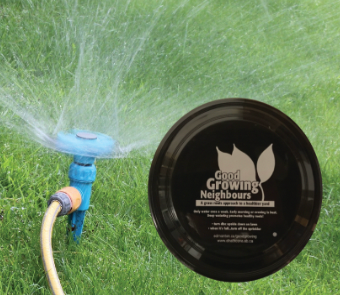
The city needed residents to water their lawns to a depth of half an inch and stop. Half an inch is completely abstract. They suggested rain gauges.
The city had a problem they couldn't solve with words.
They knew exactly what residents needed to do. Water your lawn to half an inch and stop. It was precise. It was measurable. It was completely abstract to anyone standing at a tap on a summer morning, wondering whether they had watered enough.
They had tried explaining it. They had tried measuring it. They had tried rain gauges — tools that told residents how much water had fallen from the sky, which was not the question anyone was actually asking.
The question every resident was asking was simpler and more human than any measurement tool could answer.
When do I stop?
And underneath that question, one the city hadn't heard yet:
If I do stop, then what?
The residents weren't indifferent. They wanted to help. They just had no way of knowing when the help had happened. No moment of completion. No permission to stop. No reason to feel anything except vague uncertainty about whether they had done enough.
We saw a homeowner standing at a tap, a hose in hand, genuinely trying to do the right thing and having no way to know when it was done.
A frisbee arrived in their mailbox.
Printed on the underside were three instructions: Turn this over. Stop watering when it's full. Then go have fun.
Three instructions. Three emotional beats. Measurement, permission, reward.
The city got their conservation. The resident got a moment of completion, a reason to feel good about what they had done, and something to do with the rest of their afternoon.
The Frisbee was kept. The rain gauge would not have been.

The environmental movement opposed the logging industry. We saw loggers with families who needed work, retailers who wanted to be part of something worth joining, and students who wanted an identity worth wearing.
In 1990, a 65,000-acre forest in British Columbia was scheduled for clear-cutting. The environmental movement had a position. The logging industry had a position. Both sides were entrenched. Nobody was going to win by arguing harder.
Dave was 25 years old, on the road with no marketing budget and a belief that there had to be a third way.
But first, he saw a forest that had no voice of its own.
Then he saw a divided community that didn't need to be divided. Students who cared but didn't know how to help. Retailers who were sympathetic but needed a business case. Loggers who needed work and deserved a solution that didn't require their sacrifice.
No one had to lose.
A community mill using eco-certified timber outside the park boundary provided industry workers with sustained employment and removed the economic rationale for cutting the forest. The either/or became irrelevant.
The t-shirts gave students something to become, not something to do. Forest protectors, not protesters. Every shirt sold funded five more years on the road. 180 retailers carried them. Thousands of students wore them. One network sustained entirely by the product it was selling.
He made t-shirts that didn't argue for the forest. They made the viewer feel the absurdity of destroying it before they had decided whether to care.
Two geese flying into a cloud, two roasted geese flying out. The caption: "Acid Rain."
A thousand-foot angry deer mowing over a city with a lawnmower. The caption: "Clearcut."
The shirts weren't aimed at the loggers. They were aimed at the system that forced a false choice between jobs and nature. Satire doesn't argue. It makes the viewer see something they can't unsee.
See how the 180 store retail experience serves festival merchandising today →


The brief was a t-shirt for the International Year of the Frog. The conventional response was a frog on a shirt. We saw the marketing industry deploying materials at scale without awareness of their own environmental impact.
They asked for a T-shirt with a frog on it.
The brief was simple. The International Year of the Frog. Print something. Create awareness of the global amphibian extinction crisis. A frog on a shirt seemed obvious.
Dave ran with the cause instead.
He started asking the questions nobody else was asking. What does a t-shirt need to do to be worthy of the cause it carries? What does it say about the organizations that produce marketing materials to raise awareness of environmental crises, while those very materials contribute to the destruction they are decrying?
He sourced organic cotton. Printed with water-based inks. Cleaned the screens with orange extract cleaner instead of chemical solvents. Then he attached a corn cellulose pen to a card made from 100% post-consumer paper. The card carried facts about the environmental waste of traditional marketing materials — how many trees, how much water, how much energy — and explained precisely how this promotion had been designed differently.
Then he built frog-friendly.ca — Canada's first complete resource for sustainable marketing.
In 2008. Fifteen years before sustainable marketing became a mainstream conversation.
The t-shirt wasn't the deliverable. The t-shirt was the seed. The brief asked for awareness of an amphibian extinction crisis. What grew from it was a national resource that showed an entire industry how to stop contributing to the crises it was asking others to care about.
The piece won a national gold in marketing.
But the real result was the question it planted in the minds of everyone who held it: What is the point of marketing materials that harm the world they are meant to help?
That question is still growing.

The city needed to reduce single-passenger vehicle use in a test neighbourhood. We saw families who needed a reason to make a different choice, not a lecture about emissions.
Children who could become participants. Neighbours who could become volunteers. Households already invested in their own data before they knew they were in a program.
One month before launch, a litre log was sent to every household asking residents to record their kilometres driven. By the time the program launched, they were already invested in their own data.
Upon launch, a large fridge magnet with a game designed to involve the whole family. Different points for different LocalMotion methods. Additional points for using them all. Seeded paper hangers were distributed to hang on rearview mirrors. If volunteers saw a car parked for two consecutive days with the hanger still on, the household was eligible to win a pedometer, a water bottle, or a mountain bike.
Cordon counters at every intersection verified the reduced driving.
The litre log didn't tell residents to drive less. It asked them to pay attention to how much they were driving. The game didn't convince anyone to change. It made changing feel like the most natural thing in the world.
Everything begins with a different set of questions and a different way of looking at your goal.
Prefer to reach out directly?
+1 (780) 474 • 6563
We Help Good People Do Better Marketing
Do Better Marketing
(a division of Avatar Brand Management Inc.)
Do Better Marketing sees the person behind the role. That act of seeing has protected forests, changed how business leaders see domestic violence, and hired senior engineers. Marketing Triage™. Purpose-Ecosystem™ Design. Dimensional Storytelling™. Symbiotic Systems Methodology. GreenMeets™. Edmonton, Alberta.
Promotional Products Edmonton · Branded Merchandise Edmonton · Custom T-Shirt Printing Edmonton · DTF Printing Edmonton
© 2026 All Rights Reserved
